So, you're wondering how much self storage costs in the UK? It's one of the first questions everyone asks, and the honest answer is… it depends. But don't worry, that doesn't mean you have to go in blind.
Think of it like booking a hotel room. A small single room for a weekend will cost less than a large family suite for a month. The same logic applies here. The bigger the space you need and the longer you need it for, the more it will cost. Location plays a big part too, just like a hotel in central London versus one in a quiet town.
Generally speaking, you can expect to pay anywhere from £15 to £30 per week for a small unit, perfect for a few boxes or seasonal items. Need a bit more room? A medium unit, big enough for the contents of a one-bedroom flat, typically runs between £30 and £50 per week. For those big moves or business storage needs, a large, garage-sized space will likely set you back £50 to £80 per week, sometimes more.
Average Storage Costs at a Glance
Let's break that down into some typical weekly and monthly figures to give you a clearer picture.
Here’s a table that provides a quick overview of average self storage costs for common unit sizes across the UK, helping you estimate your potential expenses.
| Unit Size (sq ft) | Typical Use Case | Average Weekly Cost | Average Monthly Cost |
|---|---|---|---|
| 25 sq ft | A few boxes, small furniture, garden tools | £15 – £25 | £60 – £100 |
| 50 sq ft | Contents of a studio or 1-bed flat | £25 – £40 | £100 – £160 |
| 100 sq ft | Contents of a 2-bed house | £40 – £60 | £160 – £240 |
| 150+ sq ft | Contents of a 3-bed house or business stock | £60 – £80+ | £240 – £320+ |
These prices are a good starting point, but remember they are averages. You'll find regional differences, and special offers can also make a big impact.
To help you visualise this, the chart below shows how the average monthly cost scales up as the unit size increases. It’s a great way to quickly see the price jump between small, medium, and large options.
As you can see, size is the biggest driver of cost.
The UK self storage market is pretty busy, which naturally affects what you'll pay. The industry average rental rate currently sits at about £29.13 per square foot, a figure that's actually gone up by 6% in the last year. That demand is spread across a massive 64.3 million square feet of storage space nationwide.
Self storage is a brilliant, flexible solution whether you're moving house, decluttering, or need space for your business. The trick is to be realistic about how much room you actually need so you don't end up paying for empty air.
One of the most common mistakes people make is guessing the unit size. It’s easy to either overestimate and waste money, or underestimate and end up with a stressful game of real-life Tetris.
The best way to avoid this is to quickly list everything you plan to put into storage. If you’re still finding it hard to visualise, our handy storage space calculator can give you a much more accurate idea. A few minutes with a tool like that can save you a lot of hassle—and cash—down the line.
What Really Drives Your Final Storage Price?
Thinking about the average cost of self storage is a good place to start, but the price you see advertised online isn’t always what you'll end up paying. It’s a bit like booking a flight – the time of year, your seat choice, and a few other things can change the final bill. Getting your head around these variables is the key to understanding how much self storage costs in the UK and finding a deal that actually fits your budget.
All these elements mix together to create your personal quote, which is why two people could rent the exact same size unit at the same facility and pay completely different prices. Let’s break down the five biggest factors that shape your final storage price.
The Impact Of Unit Size
This one’s the biggie. It’s simple, really: the more space you need, the more it’s going to cost. Renting a 150 sq ft unit, which is about the size of a single car garage, is naturally going to be quite a bit more expensive than a 25 sq ft unit, which is more like a large garden shed.
Choosing the right size is so important. If you go too big, you’re literally paying for empty air every single week. But if you try to cram everything into a unit that’s too small, you're setting yourself up for a stressful, disorganised nightmare. A little bit of planning here goes a very long way to make sure you only pay for what you genuinely need.
Why Location Matters
Where your storage facility is based plays a huge part in what you’ll be charged. A unit in a prime central London spot will have a much higher price tag than an identical one in a smaller town or a more rural spot like Exeter. It all comes down to basic property economics; higher land values and business rates in major cities get passed on to the customer.
Even within the same city, you’ll see prices vary. A facility just a few miles outside the city centre is often cheaper than one right in the thick of it. If you don't need to be popping in to access your things every day, choosing a slightly less central location can be a really smart way to save some money.
Your Rental Duration Commitment
How long you plan to keep your things in storage can also influence your weekly rate. Lots of storage places, including us here at MG Self Storage, run introductory deals like 50% off your first eight weeks to welcome new customers. These offers are fantastic for the short term, but it’s the standard rate that follows which you’ll be paying for the rest of your stay.
Beyond those initial deals, some providers will offer a lower weekly rate if you commit to a longer-term contract. For instance, pre-paying for six or twelve months upfront can sometimes unlock a better deal than a flexible, rolling monthly agreement. If you know you’re in it for the long haul, it’s always worth asking about long-term discounts.
Different Types Of Storage Units
Not all storage units are made equal, and the type you choose will directly affect the cost. The most common and usually most affordable option is a standard indoor unit, tucked away inside a larger building. These are perfect for most general household goods or business archives.
But you might come across a few other options that come at a premium:
- Drive-up Units: These give you the fantastic convenience of parking your car or van right at the unit door, which makes loading and unloading a breeze. That extra convenience often means a slightly higher price.
- Climate-Controlled Units: If you’re storing sensitive items like antique wooden furniture, electronics, or important documents, a climate-controlled unit keeps the temperature and humidity level stable. This specialised environment costs more to run, and that's reflected in the rental price.
- Container Storage: Often found at outdoor sites, these big steel containers, like the ones we offer at MG Self Storage, are a really robust and popular choice. Their cost is competitive and mainly depends on the size and the location of the site.
Seasonal Demand And Price Fluctuations
Finally, the time of year can have a small but noticeable effect on pricing. The self storage world has its own peak seasons, especially during spring and summer when lots of people are moving house. The end of university terms is another incredibly busy time.
During these high-demand periods, you might find prices nudge up a little and introductory offers aren't quite as generous. On the flip side, booking during quieter times, like late autumn or winter, could help you snag a better rate.
The UK's self-storage market is massive, with over 2,900 facilities offering a huge 64.3 million square feet of space to nearly 3% of the population. With occupancy rates hovering around 75.1%, it's clear that demand is always playing a role in how much self storage costs. You can dive deeper into these market trends in the latest industry report from Cushman & Wakefield. By understanding these five key drivers, you can start your search with confidence, ready to ask the right questions and find the best possible value.
Navigating The Extra Costs Hiding In Your Quote
The weekly or monthly price you see advertised is the big number, but it’s rarely the final one. Think of it like booking a flight on a budget airline – the seat price looks fantastic until you start adding luggage and picking your seat. To really get to the bottom of "how much does self storage cost uk?", you have to look beyond the sticker price.
Getting a handle on these extras from the start means you can budget properly and avoid that sinking feeling when the first invoice arrives. Let's pull back the curtain on the most common additional charges you're likely to encounter.
Mandatory Insurance Cover
Any reputable self storage facility in the UK is going to insist you have insurance for your goods. This is a non-negotiable step that protects your possessions against things like fire, theft, or water damage. It's a safety net for everyone.
The facility will always have its own insurance policy ready to go, which is certainly convenient as they just add it to your monthly payment. However, and this is important, you are not obliged to take their cover. You're perfectly free to find your own policy from a specialist provider. A quick search online can often unearth cheaper deals, so it's definitely worth a few minutes of your time. Just be sure to bring proof of your policy when you come to move in.
One-Off Security Deposits And Admin Fees
When you first sign up, you can expect to pay a refundable security deposit. This is standard practice across the industry and usually amounts to one or two weeks’ rent. It’s simply the facility’s back-up plan.
This deposit is fully refunded to you when you move out, as long as the unit is left clean, undamaged, and your account is all paid up.
Some of the larger national chains might also add a small, one-off administration fee for setting up your account. It’s always worth asking about this when you get your initial quote so it doesn't come as a surprise.
The Right Padlock For The Job
You’ll need a padlock to secure your unit’s door, and this isn't usually included. While you might be tempted to grab that old lock from the garden shed, hold on a minute. Most modern storage sites have specific security standards.
They’ll often insist on high-security locks, like disc locks, that are tough for bolt cutters to get through. This is for your own protection, after all. You can typically buy one from the reception shop on-site, or you can source your own beforehand, just check that it meets their requirements first.
Other Potential Charges To Consider
A few other costs can crop up depending on your situation. A successful move is all about understanding the full financial picture. For instance, beyond the storage unit, people often need to figure out how much movers cost in Toronto, which presents its own world of rates and potential add-ons.
Back in the UK, here are a few more charges to keep on your radar:
- Late Payment Fees: Fall behind on a payment and you'll get hit with a late fee. These can stack up, so setting up a direct debit is the simplest way to stay on track.
- Out-of-Hours Access: Many facilities, including our own at MG Self Storage, provide 24/7 access as part of the deal. Some places, however, may charge you extra for access outside of their standard reception hours.
- Cleaning Fees: If you leave your unit in a mess when you move out, don't be surprised to see a cleaning charge taken from your security deposit.
Choosing The Right Size Unit Without Wasting Money
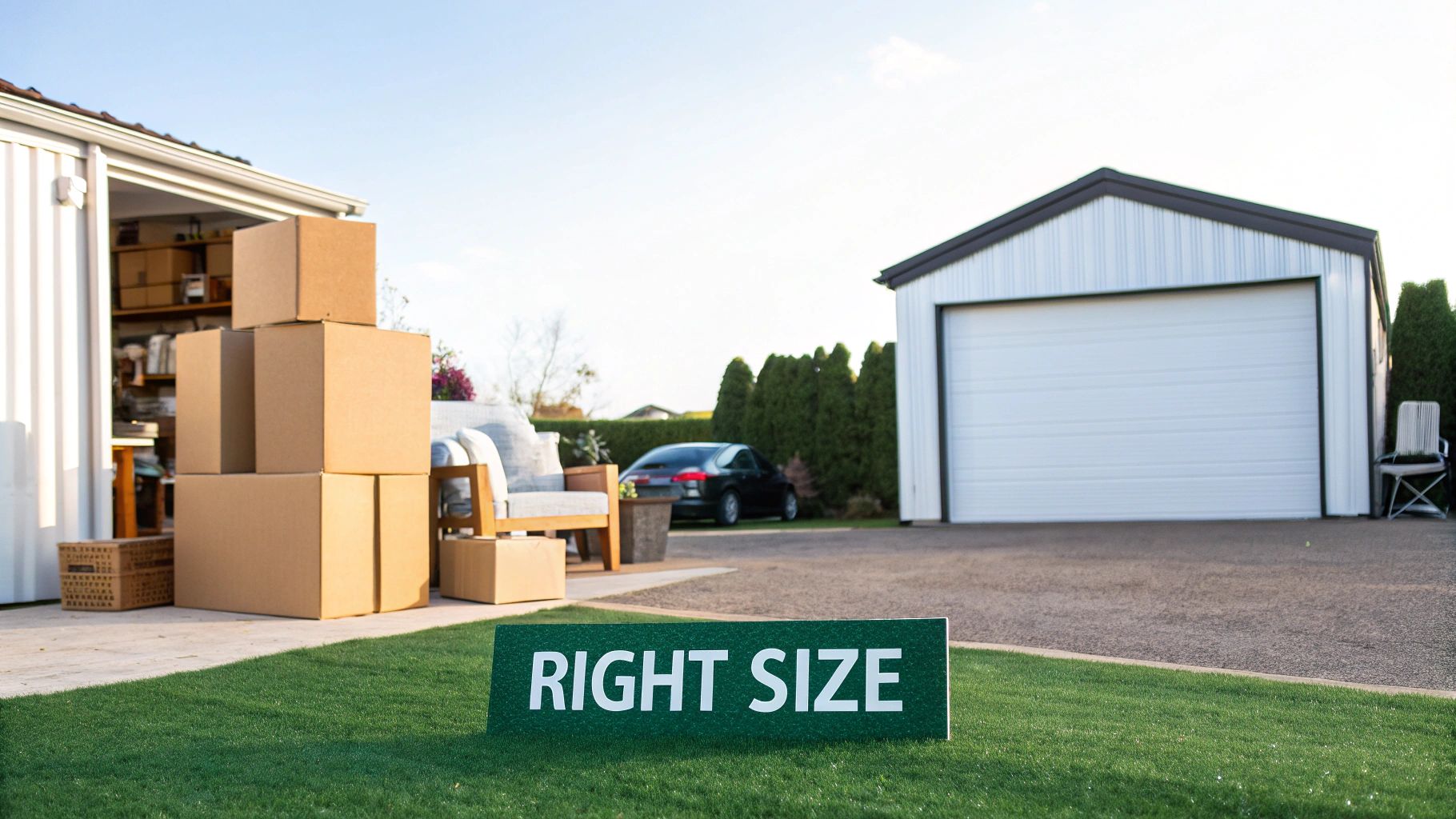
One of the surest ways to overspend on self storage is by paying for space you simply don't need. It’s the most common pitfall we see, usually the result of a last-minute panic or a rough guess that turns out to be way off. Nailing the right size isn’t just about saving money; it’s about making the whole process of storing and retrieving your things that much easier.
Trying to visualise what 'square feet' actually looks like can be a real head-scratcher. It’s much easier to think in terms of familiar spaces. For example, a small 25 sq ft unit is about the size of a large garden shed, which is perfect for stashing some boxes, a small armchair, and other bits and pieces. On the other end of the spectrum, a 150 sq ft unit is more like a single-car garage, easily big enough for the contents of an average three-bedroom house.
Thinking in these real-world terms helps turn abstract numbers into a tangible picture of what you can actually fit inside. It's also worth knowing about the different types of storage containers available, as their construction and features can influence what works best for your belongings.
Visualising Common Unit Sizes
To give you an even clearer picture, let's look at what typically fits into the most common unit sizes. Getting this right is central to answering "how much does self storage cost in the UK" for your situation, as size is the biggest factor in your final quote. A few minutes of planning here can genuinely save you a packet over the long run.
Self Storage Unit Size Guide
Here’s a handy table that breaks down the most popular unit sizes with real-world analogies to help you choose. This guide should give you a solid starting point for figuring out exactly how much space you’ll need.
| Unit Size (sq ft) | Approx. Dimensions (ft) | Real-World Analogy | Commonly Used For | Typical Vehicle Needed |
|---|---|---|---|---|
| 25 sq ft | 5 x 5 | Large garden shed | Overflow items, student belongings, about 50 medium boxes. | Estate car |
| 50 sq ft | 5 x 10 | Large walk-in wardrobe | Contents of a studio or one-bedroom flat. | Small transit van |
| 75 sq ft | 7.5 x 10 | Small Luton van | Contents of a one or two-bedroom flat. | Luton van |
| 100 sq ft | 10 x 10 | Half a single garage | Contents of a two-bedroom house. | Luton van |
| 150 sq ft | 10 x 15 | Single car garage | Contents of a three-bedroom house or business stock. | 7.5-tonne lorry |
With this in mind, you're in a much better position to estimate your space requirements accurately.
Pro Tips For Perfect Sising
Even with a guide, it can be tricky. The key is to be methodical. Before you even think about booking, take a few minutes to jot down a quick inventory of everything you plan to store. List the big items first—sofas, beds, wardrobes—and then make a reasonable estimate of how many boxes you'll need.
With your list in hand, you can use an online space calculator, a tool most reputable storage providers offer. It takes the guesswork out of the equation and gives you a far more accurate recommendation based on your actual items.
A critical part of efficient storage is thinking vertically. Every unit has a height of around 8 feet, and using that full height is like getting free space. Plan to stack sturdy, heavy boxes at the bottom with lighter ones on top, and always dismantle furniture where you can.
Thinking about how you’ll pack isn’t just about saving space; it's also about making your life easier later. If you know you'll need your winter coats in December, you don’t want them buried at the very back behind a mountain of boxes. A bit of planning for your layout can help you fit into a smaller, cheaper unit while keeping everything organised.
For a deeper dive, our detailed guide on choosing the right self storage unit size is an excellent resource. By combining a clear inventory with smart packing, you can confidently book the right unit without wasting a single pound on empty space.
Proven Strategies To Lower Your Storage Bill

Knowing what affects storage prices is one thing, but actively finding ways to shrink that bill is where you can really make a difference. With a few smart moves, you can knock a decent amount off your weekly cost without sacrificing quality or security. It’s all about knowing where the savings hide.
For starters, many facilities—including us here at MG Self Storage—have some great introductory deals, particularly for customers who book online. An offer like 50% off your first 8 weeks can make those first couple of months much more manageable. These deals are often reserved for online bookings, so it’s always worth checking the website before you call.
Beyond the initial offers, your commitment can also be your best friend. If you know you’re in it for the long haul—say, six months or more—it never hurts to ask about discounts for long-term rentals or paying upfront. Facilities appreciate the certainty of a long-term customer and are often happy to offer a better weekly rate in return.
Be Smart About Your Space
One of the easiest ways to cut costs is simply to rent less space, and that all starts with how you pack. The aim is to use every last inch of the unit you're paying for.
- Dismantle Everything Possible: Bed frames, tables, shelving—if it can come apart, take it apart. This massively reduces how much room things take up.
- Use Uniform Boxes: It’s so much easier (and safer) to stack when you use boxes of a similar size. They fit together like bricks, letting you build stable walls right up to the ceiling.
- Think Vertically: Don't just cover the floor. Stack high, with the heavy, solid boxes at the bottom and lighter ones on top.
Pack cleverly, and you might find you can squeeze into a smaller unit. That’s a direct saving you’ll feel every single month. It also pays to have a good clear-out before you even start packing; there’s no sense in paying to store things you don’t even want. For a bit more inspiration on that front, check out our guide on how to downsize your home.
Think Outside The Box To Save
Getting the best deal isn't always about just finding the cheapest sticker price. A little flexibility and creative thinking can unlock some of the best prices.
Ever considered sharing a larger unit with a friend or family member? A 150 sq ft unit is almost always better value per square foot than renting two separate 75 sq ft units. Split the cost, and you both get a secure space for less.
Don't overlook the impact of location. A facility just a few miles outside a city centre can be significantly cheaper than one right in the middle of town. If you don’t need to pop in every day, that small trade-off in convenience can lead to big savings.
This is a strategy businesses have mastered. In fact, over 680,000 UK firms—that’s 27% of all renters—use self storage to slash their traditional warehousing costs by 40-60%. A typical 100 sq ft unit costs around £240-£250 per month nationally, and choosing a smart location helps keep that figure down. You can learn more about the latest UK storage statistics and trends to see how others are making it work.
By combining these tactics, you can take control of your spending and find a storage solution that fits both your belongings and your budget.
What's Happening in the UK Self Storage Market? (And Why It Matters to You)
Ever looked at a storage quote and wondered how they came up with that price? It's not random. Understanding the bigger picture of the UK storage market gives you a bit of insider knowledge, and it mostly boils down to simple supply and demand.
Over the last few years, the need for extra space has absolutely skyrocketed. Think about it: more of us are living in cities where space is tight, new-build homes are often short on built-in storage, and thousands of online businesses are being run from spare rooms and garages. All these modern life trends mean one thing – a huge demand for storage units.
How Supply and Demand Affects Your Quote
This surge in demand directly impacts how much you'll pay. When storage facilities across the country are nearly full, they have less empty space to offer, which naturally keeps prices firm. On the flip side, if a brand new facility opens up down the road, you might see some very competitive introductory prices as they try to attract their first customers.
Make no mistake, the industry is booming, and this growth has a real effect on self storage costs. The UK's self-storage industry now turns over an incredible £1.2 billion a year, breaking the billion-pound barrier for the first time. This is driven by a 7.2% jump in available space in just the last year, bringing the total to a massive 64.3 million square feet nationwide. If you're interested in the details, you can find more on the booming self storage sector on januseurope.com.
When you grasp these market forces, you're not just getting a quote anymore. You're becoming an informed customer who gets the 'why' behind the price. This insight is your best tool for spotting a genuinely good deal and searching with confidence.
At the end of the day, knowing that storage prices are linked to these bigger economic trends helps you make sense of it all. It allows you to anticipate why prices might change and recognise fair value when you see it.
Got Questions About Storage Costs? We've Got Answers
To finish up, let's run through some of the questions we hear all the time about self storage costs in the UK. Getting these sorted will help you know exactly what to budget for and feel confident when you book your unit.
Do I Have To Pay A Deposit For A Self Storage Unit In The UK?
Yes, you can pretty much expect to pay a security deposit. It’s a standard part of the process for almost every UK self storage provider.
Typically, you'll be asked for a deposit equal to one or two weeks' rent. It’s just held as security and you’ll get it back in full when you move out, as long as the unit is left clean, undamaged, and you've paid everything you owe. It's always a good idea to double-check the exact amount and the conditions for getting it back before you sign on the dotted line.
Is Insurance Mandatory When Renting A Storage Unit?
Any reputable UK storage facility will require your belongings to be insured before you move in. Think of it as a safety net that protects your items from things you can't control, like theft, fire, or flood damage.
Most places will offer their own insurance policy, which is handy. However, you're not locked into it. You might find a better deal by shopping around with a specialist third-party insurer – just be ready to show proof of your policy to the facility manager.
Can I Get A Discount For Long-Term Storage Rental?
You certainly can. If you know you'll need storage for a good while, many providers are willing to offer a discount for a longer commitment. While a great introductory offer might get you through the first month or two, you can often lock in a lower weekly rate by prepaying for six or even twelve months.
It never hurts to ask the manager about long-term prepayment deals. It’s a straightforward way to bring your average monthly bill down.
How Often Can My Storage Price Increase?
Storage facilities do adjust their prices, usually once a year, to keep pace with running costs and the market.
Your rental agreement is the key document here – it should spell out exactly how and when prices might change, including how much notice you'll get (usually around 30 days). Remember, while your special introductory rate is fixed, the standard price it goes back to can change over time.
Ready to find a secure, affordable, and straightforward storage solution in Exeter? At MG Self Storage, we believe in clear pricing with no hidden surprises. You get 24/7 access and a friendly team ready to help you choose the perfect unit. Get your free, no-obligation quote today and see how easy storage can be by visiting us at https://mgselfstorageexeter.co.uk.